IKEA for Business · Product design
Helping businesses request a quote
The first quote request flow at IKEA for Business had a low completion rate. I redesigned it so more customers could finish.
- Role
- Product Design Intern
- Team
- Lower funnel (Conversion)
- Scope
- Quote request flow
- Markets
- Italy, then Poland and the UK
Business customers can't always just buy.
IKEA for Business sells to companies and public administrations. Many need a formal quote, with prices, delivery and assembly costs, to take to a procurement team for approval before anything is bought.
The quote request began as a quick launch. The Conversion Team already worked with checkout components and the timeline was short, so the first version reused them and went live in Spain as a test. Customers used it and other markets wanted it too, but the team decided to redesign the flow before launching it elsewhere.
I joined as a Product Design Intern on the Conversion Team in Madrid. It was my first project at IKEA and I had little context on the tool, so I started with the data.
Problem
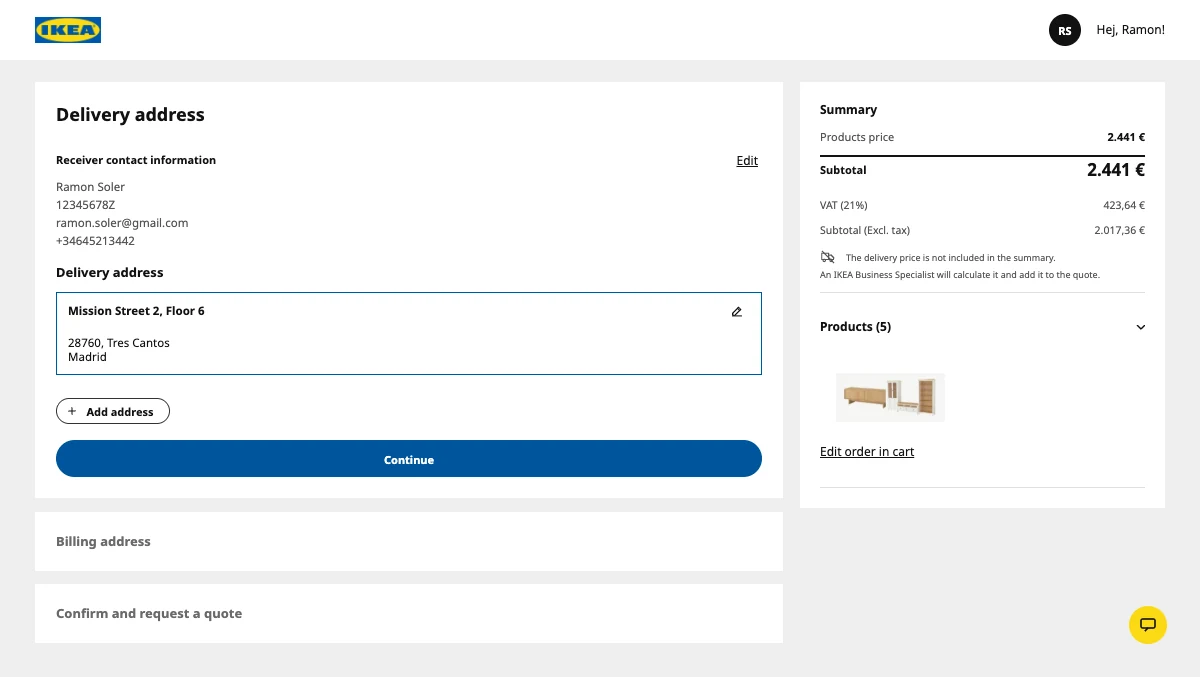
On paper, conversion from quote request to purchase looked low. Looking into it, we saw a high drop rate at the delivery address step, so fewer customers completed the request.
The ask
Redesign the flow before it goes to other markets, so more customers complete it.
Data showed where. People showed why.
My mentor and I worked with the data team, whose dashboard tracks events across the flow, to get the figures we needed. They showed where people left.
Customer days showed why. These are days at IKEA when designers sit down with real customers and test features with them informally. I sat in on them with the team, taking turns as interviewer and note taker.
They thought they were checking out
The flow reused checkout, so customers believed they were buying, not asking for a quote.
Why not a PDF now?
Prices were already on the website, so why couldn't they download a quote straight away?
The wait was a surprise
They were annoyed to wait one working day, and didn't find out until they had finished the request.
A customer, on a customer day“If I'm just asking for a quote, why are you asking for my delivery address? It makes me feel like I'm buying.”
Before / after
Key design decisions
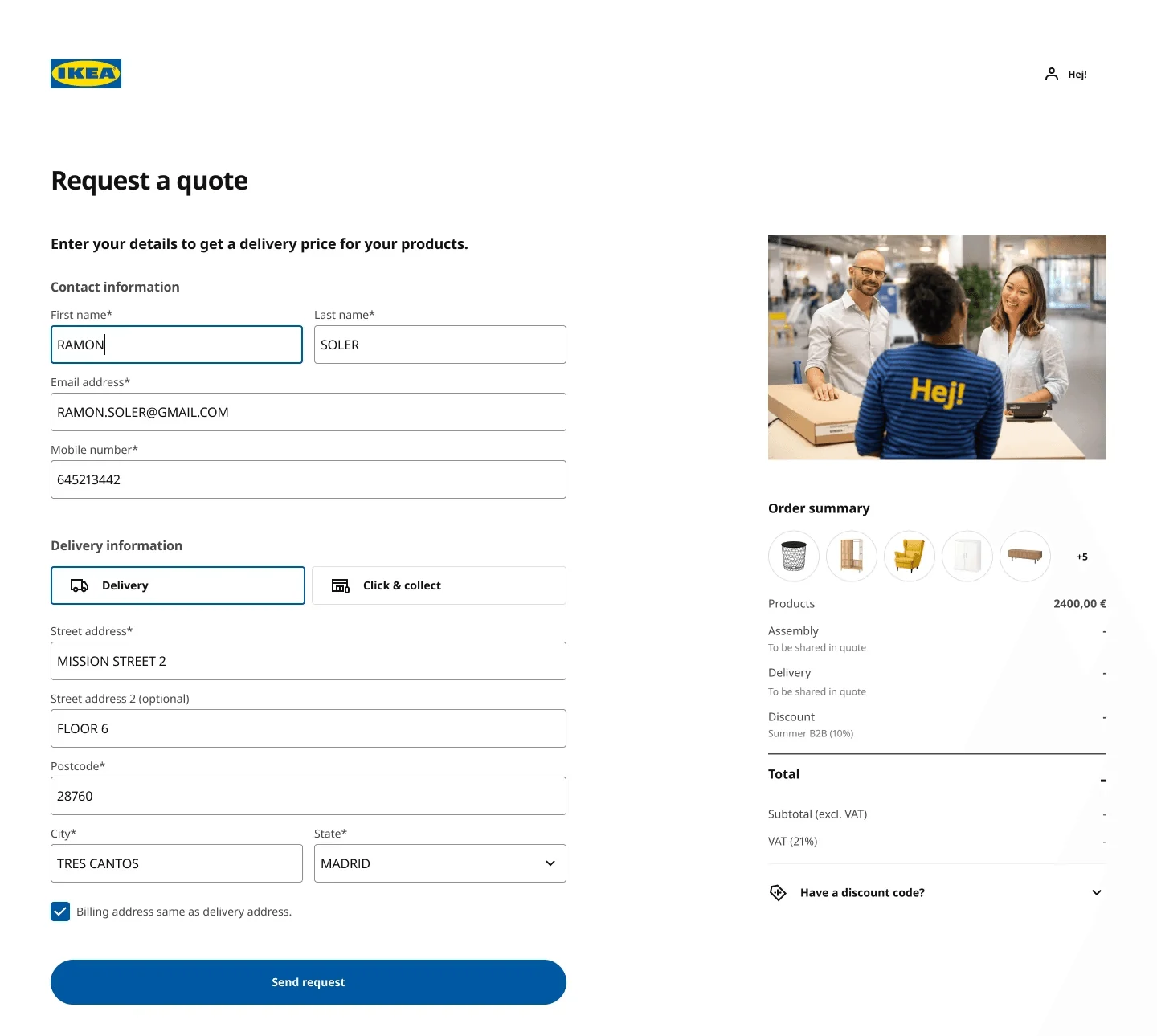
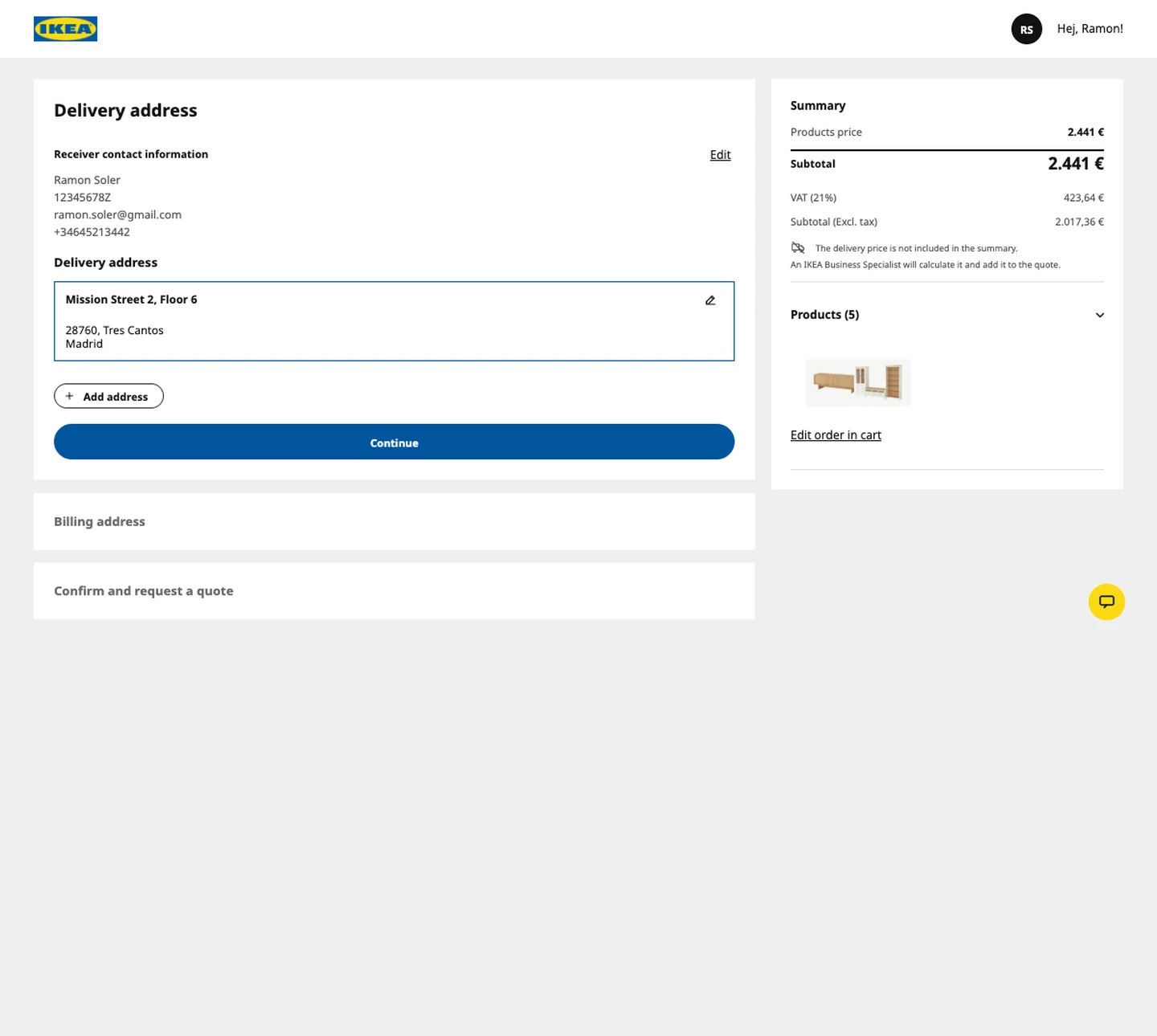
Before: a three-step checkout. People dropped off at the delivery address. After: one page that says what happens next. (demo data)
The process couldn't change, so I changed the flow.
After the customer days I went to the Business Specialists who handle every request, to understand their side. It is all manual. For each quote a specialist works out the assembly and delivery costs, which matter because quote orders are usually large quantities, and adds them to the product cost to get the customer's total. It usually takes less than a day, depending on how many requests come in, so we promise one working day.
There was no automatic way to do any of it. Adding those costs automatically, or letting customers download a PDF straight away, needed features the deadline didn't allow.
The questionHow might we simplify the quote request flow so that more customers complete it?
Low conversion didn't mean what we thought.
One customer, several quotes, one purchase is still a customer who converted. Counting purchases per quote request made a flow that was working look like it was failing.
So we redefined conversion and put more weight on drop rate: how many people leave before sending the request, and how many complete it.
Drop rate only helps if the people in the flow want to finish it. Some only want a quick price and have other ways to get one, like screenshotting their cart. They leave and it counts as a drop, but not because of the flow. So we wanted only the people who need an official quote in the flow: public administrations and corporate companies that need a document for signed approval. That's who I designed for.
Cut
Anything that made it feel like buying or slowed the form down: checkout steps, retyping what we already know, questions with no explanation.
Keep
The one working day, said at the entry point. It keeps out people who just want a fast price, and they aren't the core users, so I was fine with that.
Before / after
Count the screens.
Requesting a quote, from the cart to sent (demo data).

The cart
Tap the link
Step 1: Delivery address
Continue
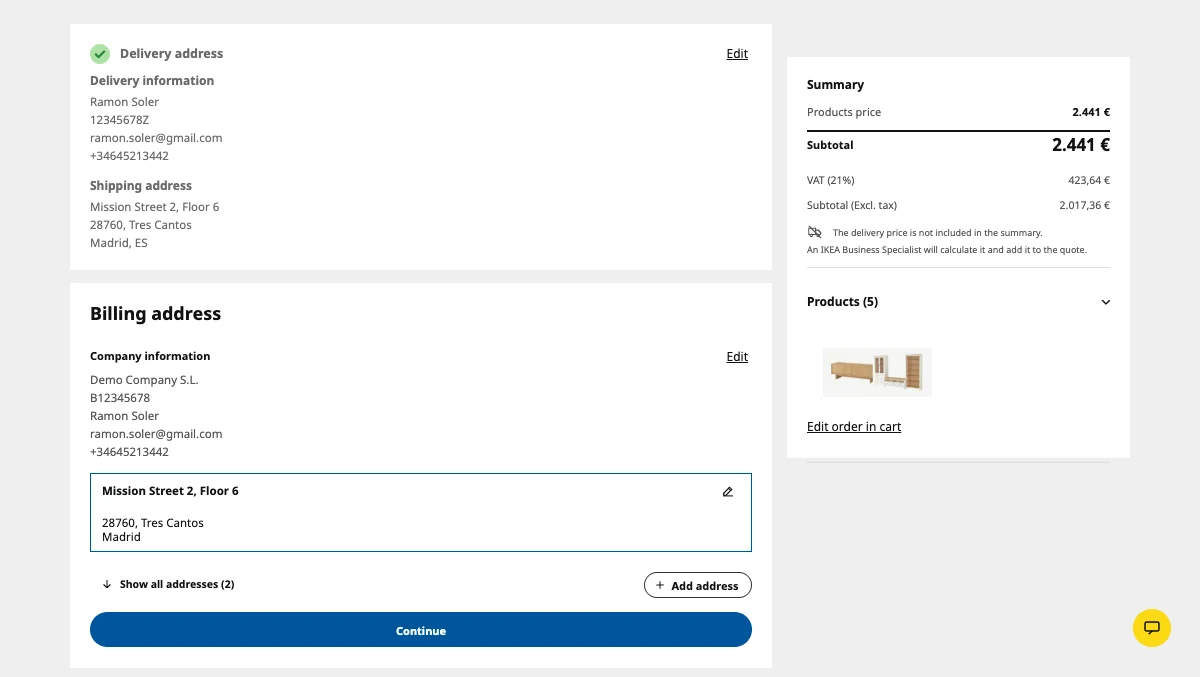
Step 2: Billing address
Continue
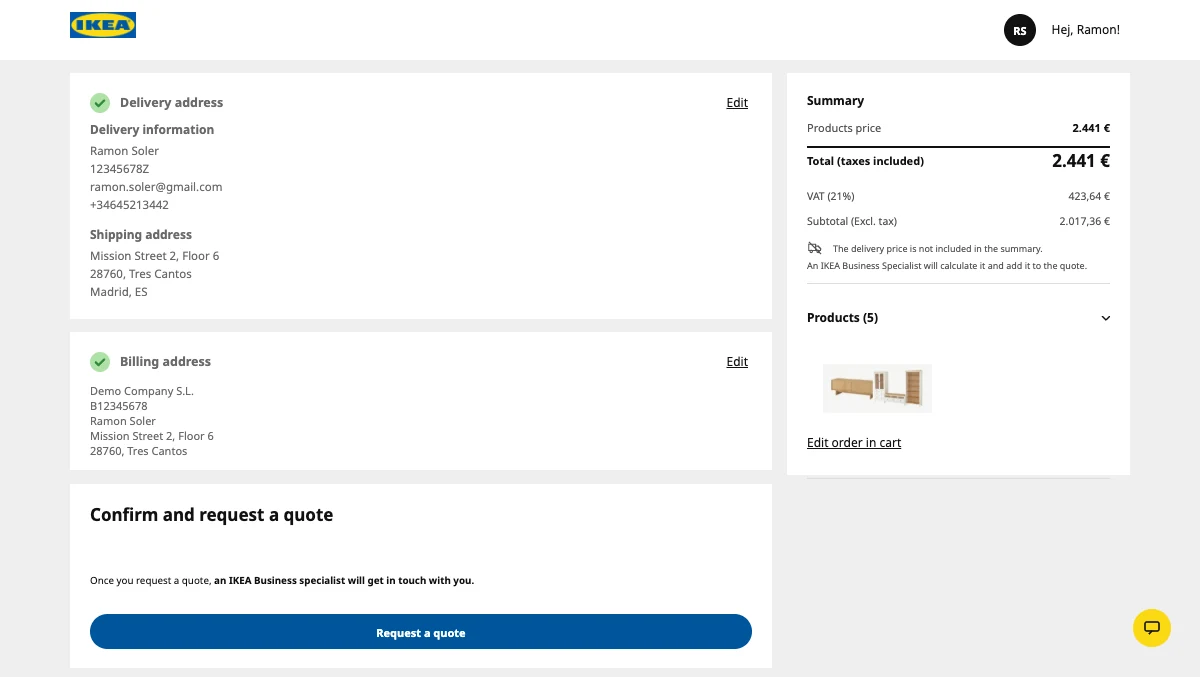
Step 3: Confirm and request a quote
Request a quote

The cart, with the promise up front
Tap the line
One page, already filled in
Send request
The quote request worked in Italy.
Before the quote request launched in a new country, it was tested. The business question was whether to bring the feature to Italy at all, and my redesign ran as a second split inside that test. Once the test supported bringing the feature to Italy, it rolled out to Poland and the UK with my redesign.
Business customers in Italy
- Half: no quote request (the control)
- Half: offered the quote request€10,000+ incremental sales in the first 11 days
- Half: the old design
- Half: the new design
What I learned.
- It was my first project at IKEA and I had little context on the tool. The fastest way in was the data, the customers on customer days, and the Business Specialists who prepare every quote.
- You need the right metrics to measure success. A quote is a comparison tool, so purchases per quote said little, and drop rate said far more.
- I couldn't change what happens behind the form, so I changed what customers see in front of it. Saying the wait up front means some people may leave, and they aren't the ones this is for.